
How does the hydraulic system, the
date:2026-01-26
The hydraulic system of a dump truck is like the human heart and muscles, which is the core of its "flexibility and stretch" and efficient unloading. Once the system fails, the entire vehicle will be "paralyzed". Today, we use the most understandable way to thoroughly explain its working principle and golden rules of maintenance.

1. Working
Principle: How does the hydraulic system "lift the stone"?
There are four
core items, none of which can be missing.
Imagine a
hydraulic system as a closed "force transfer system":
Heart: Hydraulic oil pump - driven by the
power take-off, converts mechanical energy into hydraulic energy to generate
high-pressure oil flow.
Blood: Hydraulic
oil - the medium that transmits power and is also responsible for lubrication
and cooling.
Muscle: Lifting
cylinder (commonly known as "jacking") - receives high-pressure oil,
pushes the piston rod to extend, and directly lifts the cargo box.
Brain: Hydraulic
valve group (multi-way valve, limit valve, etc.) - controls the flow direction,
pressure and flow of oil, and commands when the "top" starts, stops,
and falls.
Work flow (a
complete lift and landing)
Let's follow the
path of the hydraulic oil and look at the complete cycle:
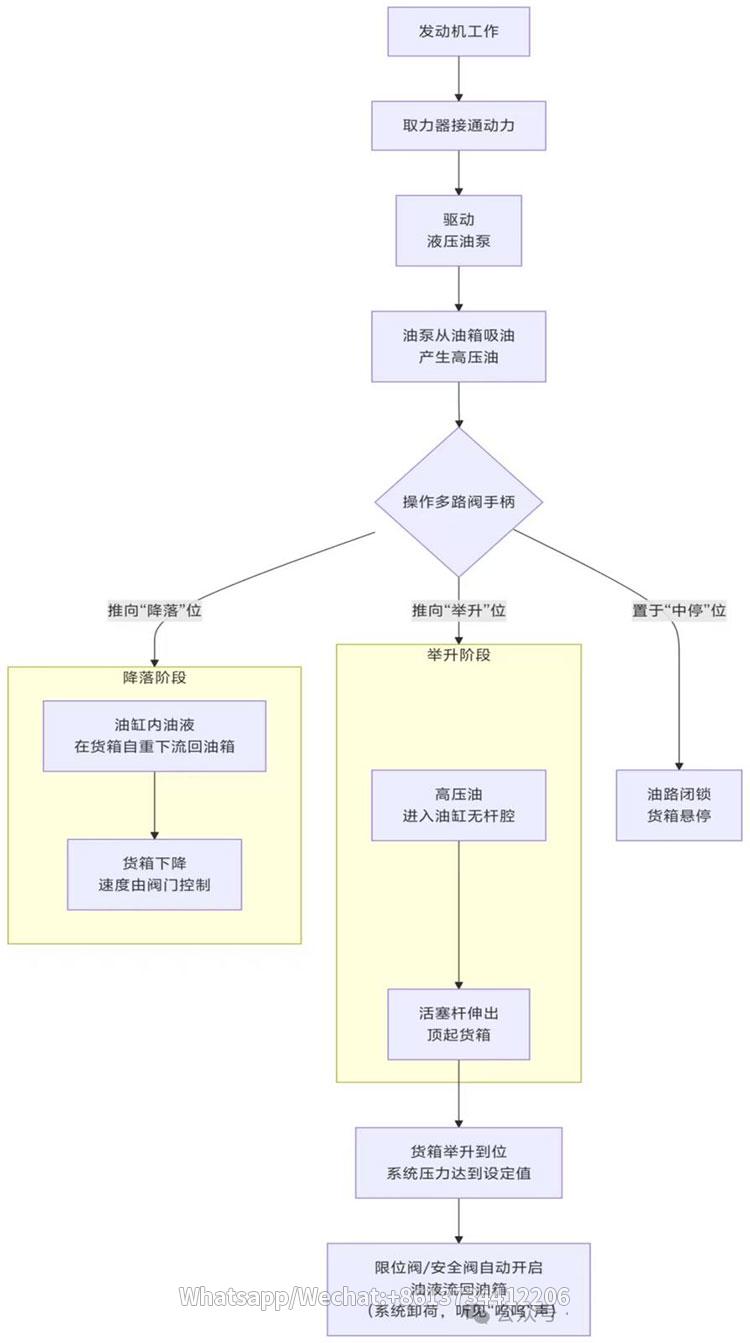
Key point: When
landing, the cargo box is pressed back into the oil cylinder by its own weight,
and the oil just flows back into the tank. Therefore, it is strictly prohibited
to drive forcefully on inclined roads or in a lifted state, otherwise serious accidents
may occur due to imbalance of oil pressure.
Maintenance
Guide: Remember the "3+3 Golden Rule" to reduce the failure rate by
80%
Hydraulic oil
"three levels" are strictly controlled
1. Choose the
right oil: Strictly follow the brands recommended by the manufacturer (such as
anti-wear hydraulic oil HM-46, etc.). Do not mix different brands and models.
2. Keep it
clean: Make sure the refueling port is clean before refueling; refueling tools
must be dedicated and clean; the fuel tank cap must be tightened.
3. Regular
replacement: The first maintenance is recommended at 2000-3000 kilometers or
500 working hours, and then every 10,000 kilometers or once a year. If the
working environment is harsh (dusty, high temperature), the cycle needs to be
shortened.
"Three
Prohibitions" for Daily Operations
1. Overloading
and unbalanced loading are prohibited: Overloading is the "number one
killer" of the hydraulic system. Unbalanced loading will cause uneven
stress on the cylinder, which can easily lead to deformation and oil seal
damage.
2. Lifting and
driving and slamming to the ground are prohibited: When driving, you must make
sure that the cargo box is completely in place and locked. After unloading, the
cargo should be landed smoothly. Do not quickly drop the cargo with one click
while in the lifted state. Huge impact will directly damage the cylinder, frame
and valves.
3. It is
forbidden to "hold the pressure" for a long time: after the cargo box
is lifted to the top, the system will automatically unload (the sound of the
oil pump will change). At this time, the lifting operation should be stopped in
time. Continued "holding" will cause the oil temperature to rise
sharply and damage the oil pump and seals.
Regularly
inspect the "three key points"
1. Check for
leaks: Before leaving the vehicle every day, go around the vehicle to check
whether there are any oil stains on the cylinder piston rod, each oil pipe
joint, and the valve block interface. Even minor leaks should be addressed
immediately.
2. Listen for
abnormal noises and smells: When working, pay attention to whether the oil pump
has abnormal noises and whether there are abnormal noises in the cylinder;
smell whether there is a smell of burning rubber (caused by overheating).
3. Observe the
status: Observe whether the lifting and descending speeds are significantly
slower, whether there is jitter or weakness. This is often a sign of oil pump
wear, cylinder leakage or oil line blockage.
Treat your
hydraulic system well and it will give you efficient and reliable feedback.
Remember - "three points of repair, seven points of maintenance", the
core of maintenance lies in clean oil, standardized operation and diligent
inspection.